
Wicked Strategy
Game-changing strategy is never certain since it applies to the unknown future. Feedback may be slow, and its meaning unclear. So, how can you learn fast enough to fix it?

👋🏻Hi. Amié here. Welcome to Beyond Better Blog. Every other week or so I share new ways of thinking about strategy, leadership and management for becoming an extraordinary founder, leader or contributor.
👁️🗨️I spend my non-writing time with ambitious leaders crafting game-changing strategy and helping people to scale!
☄️For the first time in a while I have coaching availability. Are you looking for an edge as a leader, manager or strategist—or, just a life you love? Book a call.
As it stands, I have capacity for just one new corporate coaching client or up to 3 individual clients.
If you haven’t subscribed, you missed these recent articles.
Which Hard Problem? How do you choose which problem to work on now —and which not?
Energy From the Future Our horsepower today comes from our vision of the distant and unlikely future.
My goal is to provide you with thinking worth MUCH more than the time you spend reading or listening. If you have feedback, send it along in the comments below or DM me. Let me know how to make this your favorite inbox arrival!
Subscribe to get access to all of those and every new post!
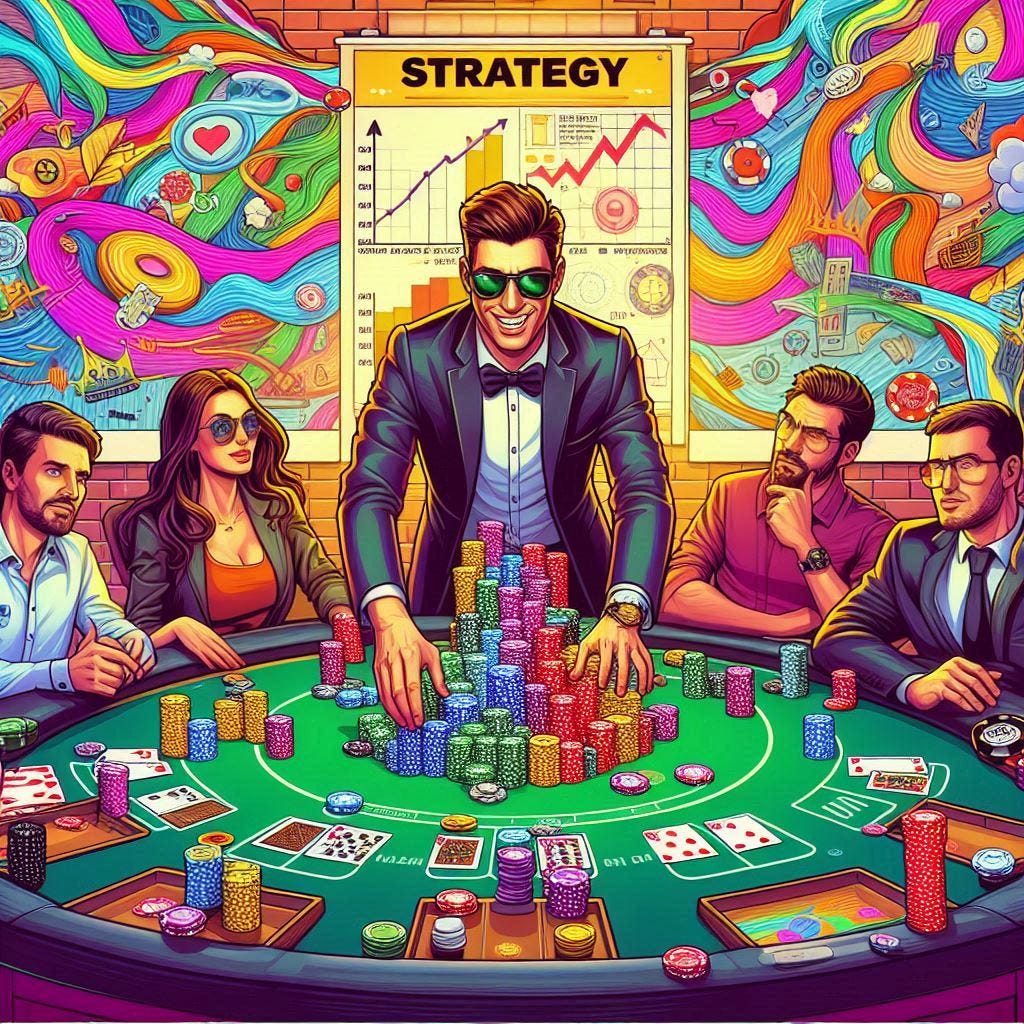
Strategy shouldn't be a gamble. Yet it has a lot in common with high-stakes poker. Both exist in a wicked learning environment where feedback isn't immediate, or easy to interpret.
Most of our knowledge has been comparatively easy to discern. As children, if we touched a hot stove, the feedback was instant—and so was the lesson. Don't touch stovetops, they burn.
But whenever we undertake crafting a strategy, especially one that’s long-term and game-changing, we face a far more challenging situation. There will not be much immediate feedback. And even the feedback we get will be of dubious value. Changing paradigms, crafting new categories or transforming an enterprise—these all take place in wicked learning environments.
Consultants rack up billable hours trying to mitigate that wickedness, collecting and analyzing reams of data hoping for clarity about what will happen next. But no amount of information cures the fundamental problem: When we craft strategy, we do so in the face of long odds and no certainty.
Wicked learning environments were first described by psychologist Robert Hogarth. He tells the story of a physician who became prominent because he could accurately predict typhoid weeks before symptoms appeared. His diagnostic test involved palpating patients' tongues with his own fingers.
It turned out that he had typhoid himself and was transmitting it through his examinations. The feedback was fast and measurable—but its value was fishy to say the least.
Experience Isn't Enough
In 2018, Jeffrey Katzenberg (co-founder of DreamWorks) and Meg Whitman (former eBay and HP CEO) raised $1.8b to launch Quibi, a short-form video streaming platform.
The preliminary hype was enormous. Hollywood luminaries like Steven Spielberg and Bill Murray signed on along with every major studio and network. Videos would cost $100,000 per minute for every 10-minute "show".
An experiment is only useful if you can isolate the variable you are testing. If you want to choose between two titles for an article, you run a test in which everything else is identical EXCEPT for the title. That tells you that any difference in results is due only to the title difference, and not to (say) different fonts, illustrations or first paragraphs.
But Quibi created a whole new level of wickedness. Their untested platform launched with a novel format, never-before-seen content, and cost $4.50 a month from day one. That's four variables.
When the effort failed, they speculated: Was it the platform's newness, or user interface? The content? Perhaps 10 minutes wasn't the right length? Or, was it too expensive?
Those are just the defining variables. Innumerable other variables lurk in every strategy: Did it solve a problem? Was there any unmet need? Who were the right customers? What alternatives did customers have?
Distinguishing which variable mattered was impossible. Despite the pedigree of its founders, Quibi shut down six months after launch.
Wonderfully Wicked
We always create strategy in the present, but it is intended to work in the future. No matter the terabytes of data analysts collect, all strategy suffers from insufficient information. The future is unknown to all of us.
As time progresses and the future becomes the present, we must parse what we observe and turn it into meaningful information. No matter how much feedback you collect, if you infer the wrong lesson, you will make poor decisions.
That's the difference between failure and success—how well we infer the right lessons. And the more wicked the learning environment, the more challenging and critical it becomes to make the right inferences.
Maersk
A.P. Moller-Maersk was founded in 1904. Today, it is a global behemoth with roughly a $183 billion market cap. Historically, shipping companies grew through scale; larger ships with greater speed, more vessels, acquisitions—it's been a war of size.
But around 2014-15, while shipping volume was huge and growing, profitability was declining. The business had become volatile. Every disruption—economic downturn, tsunami, port strike—meant hundreds of hours untangling complicated messes, upset customers, missed deadlines and unmanageable budgets.
Adding to this challenge was an onslaught of well-financed, logistics start-ups, promising to remove every headache through AI and digitization. If they gained a foothold, Maersk would lose its dominance and become fully commoditized.
This led to a 2016 commitment by Maersk's CEO, Søren Skou, to "[become] the global integrator of container logistics."
Achieving that status required transforming the enormous company and its fleet. This long-term strategic program included everything from connected infrastructure spanning the entire value chain—containers, ships and ports—and using AI on that mass of data to extract intelligence that would fine-tune operations and customer delight.
The number of moving parts and potential for unforeseen developments in shipping is huge. But that number is dwarfed when compared to what could happen during such a bold strategy. Here are just a few challenges they faced:
NotPetya cyberattack (2017): Massive disruption and ~$300 million in losses.
Interoperability: Integrating multiple platforms required a huge investment.
Regulations: Digital-first transformation increased the regulatory burden in cybersecurity, data protection, and trade.
2020 Pandemic
Although these represented unknown problems, Maersk had prepared to reduce the wickedness toll. While they couldn't have anticipated the specific ransom ware attack, or the pandemic, their approach made every challenge more manageable by shortening and clarifying the feedback loop.
The pandemic is a perfect example. By 2020, Maersk had implemented much of their logistics digitization—and they accelerated it when COVID struck. So, while shipping largely ground to a halt, Maersk customers always had precise information about their shipments. Maersk had record profits of $24 billion in 2021.
Whittling Wickedness
It began immediately after the strategy was conceived. Chief Digital Officer Ibrahim Gokcen broke the project into 3 phases, and then further reduced those into small, focused projects.
They planned their transformation to maximize opportunities for feedback, learning and iteration. They approached the strategy stages one small piece at a time, from most basic to most complex, minimizing the chances for mass losses throughout. This boils down to key principles we can all use to reduce the wickedness of our learning environments during the built-in uncertainty of strategy execution.
Strategic clarity and framing. Nothing exists in isolation from strategy. Clarify the strategic vision as context for everything. That ensures that each subsequent decision gets strategic consideration, not just financial or practical assessment.
Build from least to most complex. If Quibi had done this, they might have launched a free platform, with familiar offerings of varying short lengths. That would have reduced the variables to one: a new platform.
Shorten feedback loops. This might be a sandbox, or short-term experiments, but the learning must be systematic and perpetual.
Identify and fill knowledge gaps.
Not the Norm
These may seem self-evident when you consider Maersk's undertaking. But it’s not what most organizations do when they try to pivot strategy or undertake something game-changing.
Instead, they fail to distinguish a clear, distilled strategic vision. Grand statements that could apply to any organization lack clarity. Inspiration cannot substitute for fidelity. [Click to tweet this]
Moreover, few organizations are willing to build one step at a time. Sometimes, investors are to blame for demanding speed and breadth of execution.
But in observing my clients, it often looks like a fear-based choice. If they slowed down enough to do the hard work of reducing variables and systematically testing and iterating, they might discover that the strategy is invalid. That's terrifying.
But wouldn't it be better to discover that early instead of simply suspecting it when you've spent every penny and calorie?
If you do too much at once, you make learning impossible. Then, even once you have failed, it isn't entirely clear why. But the window of opportunity to test and learn has closed.
Game-changing strategy takes place in a wicked learning environment. That's what makes it hard and rare. It’s also part of its appeal.
Those of us who live and breathe strategy love the uncertainty; but we love it like a cryptic crossword puzzler loves hard clues. It isn't about the adrenaline of a big bet. Instead, it's about the challenge of solving the puzzle by learning fast enough to meet the challenge of whatever the future delivers.